
Research and planning edition: November 14, 2026 | Guidance for travel in 2026 and 2027
The most memorable animal encounter in Peru may be the one that never becomes a close-up photograph. A river otter continues fishing because the boat remains at a distance; a condor circles without being followed; or a macaw returns to a clay lick after observers fall silent. Ethical wildlife tourism is not a promise of a spectacular sighting. It is the practice of enjoying living ecosystems without changing the behavior, health, or survival chances of the animals in them. Peru makes that choice unusually important: visitors move between Amazon rainforest, Andean puna, high lakes, and the Pacific coast, each with different species, access arrangements and conservation pressures. This guide explains what to look for before booking, how to behave during encounters and how to tell a meaningful conservation activity from an attractive but harmful one. It reflects publicly available information checked in November 2026, and distinguishes recommended behavior from site-specific law.
What should travelers know at a glance?
Peru’s national protected-area authority, SERNANP, advises visitors to stay on marked trails, avoid feeding or disturbing wildlife, maintain a safe distance and avoid flash photography. Those are sound default behaviors even outside protected areas. Wildlife cannot be guaranteed, and wildlife care or rehabilitation facilities should not be confused with places designed for tourists to handle animals. Always check whether the tour operates in a national park, reserve, community territory or ordinary private land; the rules and authorization processes may differ. More expensive does not automatically mean more ethical. A small, well-managed excursion with a trained local guide can have a lighter footprint than a luxury trip with uncontrolled approaches.
| Experience | Ethical opportunity | Main red flag | Best verification |
|---|---|---|---|
| Amazon river excursion | Observe animals from a quiet boat | Chasing otters or caimans | Guide’s approach rules and legal route |
| Macaw clay lick | Watch natural feeding behavior | Calling birds, bait, excessive crowding | Viewing platform and time restrictions |
| Andean condor viewpoint | Observe soaring birds | Bait or walking toward a roost | Established viewpoint and guide behavior |
| Coastal wildlife boat | See seabirds and sea lions | Approaching breeding groups too closely | Authorized route, vessel safety and reserve rules |
| Community conservation visit | Pay local hosts and guides fairly | Staged animal handling for tips | Local management and transparent payments |
What does “ethical” mean when the animal is wild?
An animal is wild when its normal behavior is governed by its environment rather than by tourist schedules. Its feeding, movement, nesting, rest and reactions to predators have ecological functions. An ethical visit should leave those functions intact. The photograph may be less dramatic, but the encounter remains real. A guide should say plainly that an animal may not appear.
The right measurement is not how close a visitor gets. It is whether the animal can choose to stay or leave without being blocked, pursued or lured. Observe the whole scene: the number of people, noise, available escape routes and the time spent at a sensitive feeding or nesting site. Different species react differently, so an arbitrary universal distance is not adequate.
Choose itineraries that describe viewing methods instead of listing guaranteed species. Ask whether guides use binoculars, scopes or fixed observation points. Ask what happens if the animal moves away. The answer should be that the group accepts the encounter ending, not that the boat or guide will pursue it. A credible supplier can explain its boundaries without becoming defensive.
Imagine two tours seeing the same capybara on a riverbank. One boat turns its engine down and remains outside the animal’s obvious flight zone. The other accelerates toward shore so passengers can take selfies. Both may advertise a capybara sighting; only the first puts the animal’s freedom of movement before the image.
Practical takeaway: Evaluate guide decisions and animal responses, not the number of species promised.
Which protected areas and rules matter in Peru?
Peru protects landscapes through national parks, national reserves and other conservation categories. SERNANP manages the national system of natural protected areas and publishes visitor guidance. National parks generally protect ecosystems under stricter use conditions, while some reserves permit regulated sustainable use. This distinction affects where boats go, which trails can be used and what activities require prior authorization.
A useful way to interpret this is to think about the situation on the ground. A lodge near a park boundary is not necessarily located inside the protected area. Conversely, a short tourist excursion can enter a restricted sector that requires the correct ticket or approved operator. Visitors should ask the exact site name and access sector. Administrative authority may also involve regional conservation areas, community territories or private conservation agreements rather than SERNANP alone.
For an actual booking, the distinction matters. Request the operating route in writing, including the name of the reserve, its entry permission and the guide arrangement. Rules about drones, commercial filming, nighttime access and camping are particularly site-dependent. The phrase “eco-tour” is not a legal authorization. When guidance conflicts, follow the instructions of the relevant park authorities and on-site rangers.
A traveler comparing lodges near Puerto Maldonado sees “Tambopata wildlife” on both listings. One includes regulated reserve visits; the other explores private trails outside the reserve. Both can offer meaningful experiences, but conservation fees, trail rules and likely habitats may differ. Ask exactly where each outing occurs.
Practical takeaway: Identify the management authority and route before assuming the trip includes protected land.
Why is feeding wildlife so damaging?
Feeding changes the relationship between people and animals. A monkey conditioned to take fruit from visitors may approach aggressively, bite, abandon normal foraging or become vulnerable to disease. Even apparently harmless foods can disrupt an animal’s diet. Food scraps also attract rodents or other scavengers to camps and viewing areas, spreading impacts well beyond the original encounter.
The practical detail is easy to miss. The same logic applies when a boat drops fish near a caiman, a guide throws food to attract birds, or a hotel leaves snacks on balconies. Feeding is not made ethical by saying the animals are already accustomed to it. In many protected settings it contradicts explicit visitor guidance. Keep lunch and snack waste secure, especially at boat stops and forest camps.
It also changes how you should prepare. Avoid any experience advertising “feed a wild monkey” or a guaranteed feeding encounter without an independently documented conservation purpose and permission. Ask guides not to offer food for photographs. If another traveler feeds an animal, tell the guide discreetly; an argument shouted near the animal causes additional disturbance.
At an Amazon lodge, a curious squirrel monkey appears near breakfast. The enjoyable moment is watching it navigate the trees; the wrong response is offering banana peel or bread. The animal may return tomorrow, teaching future guests that humans are food sources.
Practical takeaway: Never feed wildlife or allow your food to become an attraction.
How close can visitors approach without disturbing animals?
There is no single safe distance for every species and habitat. A sea lion colony, giant river otter family, nesting bird and high-Andean vicuña have different thresholds. Behavior is the first signal: stopping feeding, looking repeatedly toward visitors, moving young, calling in alarm or retreating are reasons to increase distance. Wide-angle close-ups are not a goal worth disturbing wildlife for.
There is another side to this decision. A telephoto lens, binoculars and patience reduce the pressure to move closer. On a boat, a quiet approach from an appropriate direction often matters more than the numerical distance alone. Do not block an escape path, form a ring around an animal or separate a parent from its young. Silence helps, but a silent crowd can still be too close.
The sensible response is to plan for more than one outcome. Ask your guide to establish an observation boundary before reaching the site. Confirm who decides when to stop or retreat, and whether the group leaves if the animal shows stress. Respect the rule even when another operator behaves differently. Group size, viewing duration and location can be as important as distance.
At a condor viewpoint, the bird may pass overhead naturally. Moving beyond a barrier to intercept its flight adds no genuine knowledge and can damage sensitive terrain. A long lens and a patient wait produce a more respectful experience.
Practical takeaway: Treat behavior changes as a signal to stop and move away.
What should a responsible Amazon wildlife guide actually do?
Good guiding is interpretation and risk management, not merely locating animals. A skilled guide explains habitat, tracks, calls, seasonal foods, threats and uncertainty. They coordinate quiet movement, avoid excessive flash use, know the route and respect ranger instructions. In the Amazon, understanding the water level and recent rainfall can determine whether a trail or landing point is safe.
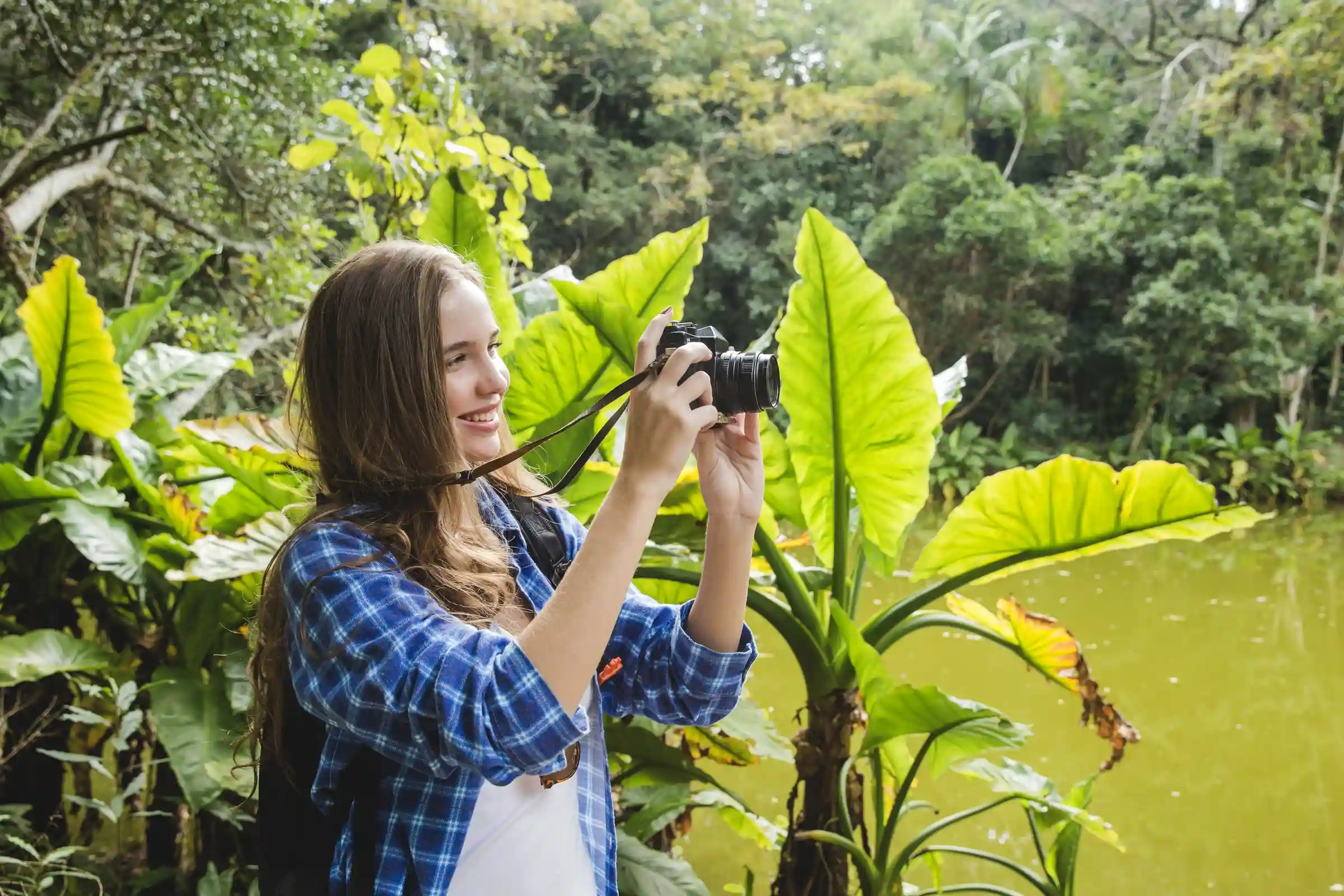
In everyday travel terms, this means something quite specific. Visitors should expect a briefing about walking distance, heat, humidity, insect protection, footwear, boat safety and what to do when a snake or large mammal appears. Guides should not handle a snake solely to entertain guests. Flash photography can be especially disruptive at night; use approved low-light methods and follow site rules.
Before committing money or time, check the operating conditions. Ask how many guests share a naturalist guide and whether night walks use designated routes. An ethical operator has a response for missed sightings: interpreting tracks, plants, insects and ecosystem relationships rather than creating artificial encounters. Request examples of conservation conduct, not unverified promises of seeing a jaguar.
A guide finds fresh tapir tracks but no animal. Instead of rushing off-trail, they explain the size of the footprint, likely time of passage and habitat use. The group gains real understanding while leaving the tapir undisturbed.
Practical takeaway: Prioritize interpretation, restraint and safety over a checklist of guaranteed animals.
Why are macaw clay licks a special ethical test?
Clay licks bring birds together at predictable natural sites, making them attractive to tourism. Yet the gathering is influenced by weather, disturbance, season and local ecological conditions. A spectacular photograph can tempt groups to crowd viewing positions or play calls. Birds may delay or skip landing when they feel unsafe.
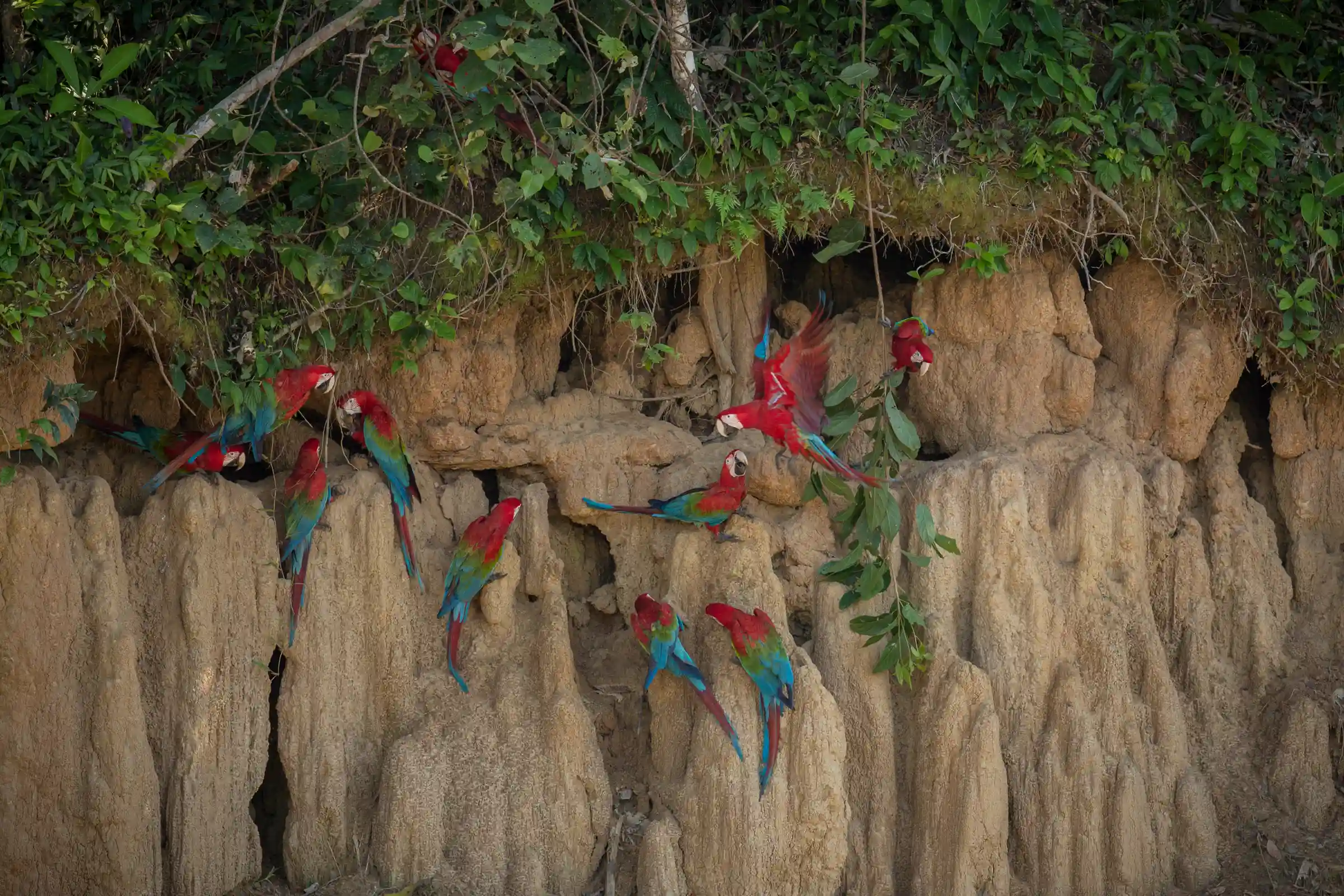
For visitors who have never traveled in this environment, context matters. Reliable guides typically work from established viewing areas, watch quietly and accept that the action may be brief. Dawn departures may improve the possibility of a visit but cannot guarantee feeding. Guests who travel only for one “perfect” clip can become disappointed and pressure guides to act badly. A broader forest-birding program creates more rewarding expectations.
A responsible operator should be able to explain the trade-off. Ask whether the viewing place is fixed, whether flash and playback are permitted and what happens during a poor weather morning. Avoid operators who say they can summon macaws on demand. A responsible plan may involve waiting patiently through quiet periods or leaving because birds do not approach.
After a night of rain, macaws gather in the trees but do not descend. The ethical guide discusses predator vigilance and weather without attempting to lure them. The outcome is still a real encounter, even if the clay wall remains empty.
Practical takeaway: Let birds choose whether to use the clay lick.
Can visitors ethically see jaguars and other elusive predators?
Wild jaguars are rare sightings in Peru, and their presence in the ecosystem does not make a sighting likely on a short tour. Claims that an operator “guarantees jaguars” are a major warning sign. Predator tracking is valuable for scientific monitoring when conducted with authorized methods; it is not an invitation for tourists to invade habitat or follow animals.
Wildlife tourism can support large-carnivore conservation through guide employment, habitat protection and broader public interest. But tourism also adds boat traffic and noise. Camera-trap images may demonstrate that jaguars live in a region; they do not prove that a tourist will observe one. Never disclose precise coordinates of dens or breeding sites online.
Ask what a trip offers if no large mammal appears. A strong itinerary can include giant river otters, birds, amphibians, insects, forest ecology and conservation interpretation, all without guaranteed outcomes. The best conservation narrative is honest about habitat threats such as deforestation and fragmentation.
A family chooses between a short “jaguar safari” ad and a multi-day natural history itinerary. The second explains realistic probabilities and local conservation projects; it is more credible even if it seems less dramatic in marketing.
Practical takeaway: Do not reward impossible sighting guarantees or intrusive predator pursuit.
What is the ethical way to see Andean condors?
The Andean condor depends on open landscapes, soaring air currents and suitable roosting habitat. Colca Canyon’s Cruz del Cóndor is a famous viewing location because it allows observation from established viewpoints. Morning conditions are often favorable, but birds do not follow a timetable. Baiting, approaching roosts and flying drones close to birds can cause disturbance.
A useful way to interpret this is to think about the situation on the ground. Viewing depends on wind, visibility, season and the birds’ behavior. A busy viewpoint does not justify leaving the marked area. Ask the guide about local conservation risks and how tourism should avoid adding pressure. Bring sun protection and warm layers: early departure from Arequipa can be cold at altitude even on a bright day.
For an actual booking, the distinction matters. Choose observation from managed viewpoints, not a promise of feeding or forced interaction. If your larger itinerary includes Colca, consider a slower overnight visit that allows flexible timing. A day trip can still work, but an animal is never obliged to appear during a short scheduled stop.
A condor flies far down the canyon. Rather than pushing through barriers for a closer image, a visitor watches its wings adjust to the rising air and listens to the guide explain why thermal conditions matter.
Practical takeaway: The ethical condor photograph comes from patience and viewpoint discipline.
How do coastal excursions affect sea lions, penguins and seabirds?
Peru’s cold Pacific upwelling system supports marine animals whose breeding, feeding and resting routines can be disrupted by boat traffic. At protected island groups such as Ballestas, safe operations require respecting navigation routes and instructions. A responsible boat does not deliberately provoke sea lions, approach breeding areas too closely or throw food to birds.
The practical detail is easy to miss. Visitors should use a life jacket when required, avoid loud calls, secure loose items and never toss plastic or food overboard. Wildlife observations may be affected by sea conditions and port-authority closures. A cancelled departure is frustrating, but safety and conservation conditions are more important than the itinerary.
It also changes how you should prepare. Look for an operator that confirms marine weather, vessel capacity, authorized access and waste practices. Ask whether the boat might return early when conditions change and how refunds or rescheduling work. Do not assume a spectacular wave or turbulent crossing is part of the adventure.
A group sees sea lions resting near shore. An ethical captain holds a sensible position and avoids running an engine into the group’s escape path. A closer selfie from an intrusive boat would cost the animals more than it gives the traveler.
Practical takeaway: Choose authorized routes and captains who respect wildlife response and sea conditions.
Is touching a captive animal the same as conservation?
No. A place described as a sanctuary, rescue center or conservation project may have very different purposes and standards. Some facilities legitimately rescue animals that cannot be released, while others use the language of rescue to sell handling opportunities. Frequent passing of wild animals between tourists is not evidence of rehabilitation and may create welfare and disease risks.
There is another side to this decision. Ask whether the facility is appropriately authorized, how animals arrived, whether releases occur, whether visitors can touch or feed them and whether staff have trained veterinary care. Avoid taking a photograph holding a sloth, monkey, wildcat or parrot simply because a handler offers it. An ethical center may permit observation without contact.
The sensible response is to plan for more than one outcome. A strong facility explains the species’ welfare needs and limits interaction, even when guests want a closer experience. Transparent financial reporting and reputable conservation partnerships are useful signals, but no single certificate replaces observation of actual behavior. Check local requirements before making a public claim that a facility is illegal.
Two attractions offer a rescued macaw encounter. At one, the bird rests in an enclosure with a story of rehabilitation; at the other, it is continuously carried between strangers for photographs. These are fundamentally different experiences.
Practical takeaway: Observe animal welfare and the institution’s actual work rather than trusting the word “sanctuary.”
How should travelers photograph wildlife responsibly?
Use focal length, crop carefully and favor natural light rather than trying to create a close encounter. Flash, playback of bird calls, drones and artificial lighting may be restricted or disruptive. Even when permitted, their use requires consideration of animal behavior. Do not expose nesting sites, dens or sensitive trail coordinates in geotagged posts.
In everyday travel terms, this means something quite specific. Plan camera settings before the animal appears. Carry batteries in dry protection and use a camera strap on boats. At night, follow the guide’s lighting instructions; do not shine a bright torch at an animal for a prolonged time. Photographs should be captioned accurately: a rescued animal in a facility is not a wild sighting.
Before committing money or time, check the operating conditions. Ask in advance whether professional commercial filming requires a permit, particularly inside protected areas. SERNANP advises that commercial photography and filming may require special authorization. A personal camera is not automatically the same as a commercial production, but bulky equipment may require review at particular sites.
A traveler with a long lens photographs a nesting bird from the public trail. They avoid publishing the exact nesting branch online. Another person crosses the vegetation barrier and geotags the nest; that online exposure can magnify the original disturbance.
Practical takeaway: No photograph justifies altering an animal’s essential behavior.
Can community-based tourism protect wildlife?
Local communities can play a central role in forest monitoring, guiding, habitat stewardship and benefit-sharing. Income connected to intact habitat may strengthen incentives to conserve it, but the outcome depends on governance and fair payment. A visitor does not automatically support conservation merely because the brochure features a local person.
For visitors who have never traveled in this environment, context matters. Ask who owns the enterprise, how guides and hosts are paid, what happens to conservation fees and whether visits have community approval. Cultural encounters should be voluntary, with consent for photographs and limits on access to private spaces. Avoid treating residents as part of a wildlife display; their priorities and rights are independent of tourism.
A responsible operator should be able to explain the trade-off. Choose a community-led experience with clear arrangements when available. Purchasing locally made crafts at a fair price may be useful, but do not pressure anyone to stage dances, hunting demonstrations or animal encounters. Peru introduced a new community tourism regulation in July 2026; it is worth checking current implementation for specific destinations.
At a community-managed forest, a guide explains why a trail is closed during nesting. The visitor’s willingness to accept this decision is part of supporting the community’s stewardship, not a lost service.
Practical takeaway: Look for meaningful community control and transparent benefits.
What should a responsible tour do with waste and supplies?
Litter is not the only environmental impact of a trip. Boat fuel, wastewater, batteries, disposable packaging, food leftovers and trail erosion can accumulate in sensitive habitats. A tour that advertises a “plastic-free” bottle while discarding other trash in the forest is not truly low impact. The logistics behind the scenes matter.
Ask about refillable drinking water where safe, waste return to town, toilets, recycling capabilities and disposal of batteries. Waste management differs considerably between river lodges and remote camps. Pack toiletries with minimal packaging and never wash directly in streams with soap or detergent. In sensitive sites, remain on approved paths.
Avoid overclaiming perfect sustainability: rural collection infrastructure can be limited, and even conscientious operators face constraints. Look instead for specific actions and willingness to explain gaps. A responsible company can describe how supplies arrive and what is done with waste after guests leave.
A trek operator packs food in reusable containers and carries waste back to a serviced town. A competing operator leaves plastic waste near a trail shelter. The first has a visible system rather than a vague promise.
Practical takeaway: Ask how waste exits the landscape, not just what happens during the tour.
What health and safety boundaries matter during wildlife encounters?
Animal bites, scratches and direct contact can expose travelers to infection. Remote travel can also involve heat, dehydration, river hazards, insects and limited evacuation routes. The appropriate response to a wild animal is observation, not touching or capturing. A guide should know the evacuation plan and where help can be requested, without promising immediate aircraft rescue.
A useful way to interpret this is to think about the situation on the ground. Bring prescription medicines, basic personal first aid supplies and appropriate repellent. Seek pre-travel clinical advice about vaccinations and bite management relevant to your route. Report any bite or scratch promptly; do not wait until returning home to ask whether post-exposure treatment is needed. Keep children close and explain the no-touch rule before a walk.
For an actual booking, the distinction matters. Ask which activities are suitable for minors and travelers with mobility limitations. Private boat or lodge access may be much easier than uneven remote trails. Confirm how the operator contacts medical assistance if mobile signal is absent. Travel insurance should explicitly address the planned activities and geography.
A snake crosses the path. The guide gives it space, asks the group to stop and lets it leave. Picking it up for a photograph would introduce avoidable risk to both snake and guests.
Practical takeaway: Personal safety and animal welfare usually point toward the same rule: keep your distance.
How do you evaluate wildlife claims before paying?
A good product page distinguishes habitat potential from actual sighting probability. Look for the precise location, time spent in the field, guide expertise, accommodation and transportation arrangements. Photographs may illustrate species found across a broad region without proving that those animals occur at the itinerary’s exact sites. Ask whether every photograph depicts a tour observation.
The practical detail is easy to miss. Review negative feedback for patterns involving baiting, guide pressure, poor boat safety or animals being handled. Check whether the supplier explains weather-related changes and refund terms. Booking through a formal registered agency reduces some transactional risks but does not by itself certify ethical practice. Good judgment combines documentation and observable behavior.
It also changes how you should prepare. Request a written itinerary with protected-area fees and access sectors stated. Ask whether groups are combined with another operator and who is responsible on the ground. Ethical questions should be answered before payment. A vague “trust us” reply is less useful than a clear description of routes, viewing limits and ranger requirements.
A listing claims “100 percent wild jaguar encounters” in a two-night trip. Another describes trails, boat outings and realistically possible animals. The second is the safer choice because it does not require unnatural interventions to satisfy the advertising.
Practical takeaway: Prefer precise, falsifiable operational claims over dramatic marketing guarantees.
Where does Machu Picchu Team fit into an ethical itinerary?
Machu Picchu Team publishes travel options ranging from Andean cultural routes to wildlife-related destinations. Its Colca Canyon full-day tour describes condor observation from established viewpoints and scenic travel through high-altitude landscapes. For Amazon trips, published Manu and Tambopata offerings can be compared by route, length and included experiences.
There is another side to this decision. A responsible decision still requires confirmation of the exact local operator, guide credentials, protected-area arrangements, boat safety and animal-viewing practices for the selected departure. A product page is a useful starting point, not independent evidence that every future outing will be conducted identically. Request details about equipment, group size and seasonal adjustments.
The sensible response is to plan for more than one outcome. For private arrangements, ask the reservations team whether the schedule can prioritize quiet observation rather than rushing between photo stops; flexibility and any extra fee should be agreed in writing. This helps turn broad ethical principles into a practical booking decision. Do not assume particular conservation certifications or rescue partnerships without supporting documents.
A traveler wants both condor watching and a cultural lake trip. They can compare the Colca itinerary with Lake Titicaca day tours, then choose a sensible pace rather than compressing wildlife stops into an unrealistic transfer day.
Practical takeaway: Use the agency’s published itineraries to ask better questions, not as proof of unverified conservation claims.
How can you put this information into a realistic travel plan?
A useful five-day nature-centered plan might spend two nights near Puerto Maldonado for rainforest walks and river observation, followed by a buffer day before flying onward; a different traveler may devote three days to Colca viewpoints and village visits. These are illustrations, not fixed itineraries or guarantees. Preserve spare time around weather-dependent navigation, travel with certified local services and keep the opportunity to cancel an intrusive activity without bargaining away the welfare of the animals. Budget separately for national reserve admission, specialist guides, transport, photographic permits where required and tips. In the wet season, access may be slower even when bird activity is excellent. In the drier months, trails can be more manageable, but conditions change year by year. Ask about current weather rather than treating a calendar month as a promise.
What should you pack, confirm, and discuss before departure?
Carry neutral-colored lightweight layers, waterproof protection, closed shoes with reliable grip, water, repellent, sunscreen, a hat, binoculars if you have them and a compact camera with a suitable lens. For Amazon travel, use dry bags and bring spare batteries; for the Andes, add insulation and protection from strong ultraviolet radiation; for coastal boats, bring wind protection and a secure camera strap. Keep required identification, insurance details and personal medication accessible. Travelers with mobility aids, hearing support, professional camera rigs, drones or special medical needs should inform reservations well in advance. Ask whether a specific item is prohibited or requires authorization. Take your litter home, never collect feathers or animal products and do not transport live animals or wildlife souvenirs across borders.
Frequently asked questions
Does an ethical wildlife tour guarantee animals?
No. Wildlife follows its own behavior and environmental conditions. A guide can improve the chance of observation without guaranteeing a particular species.
Is it acceptable to touch a sloth or monkey at a rescue center?
Treat hands-on encounters as a warning sign and ask about the facility’s authorization, welfare policy and release work. Observation without contact is usually safer for the animal and traveler.
Can I use flash photography at night?
Do not use flash unless local rules and the guide explicitly permit an approach that will not disturb animals. SERNANP advises avoiding flash in protected areas.
Are national parks open everywhere to tourists?
No. Access is managed by zones, routes and conditions. Check the specific park and entrance sector before departure.
Are all community tours conservation projects?
Not necessarily. Look for community governance, fair pay and measurable habitat benefits rather than assuming every cultural visit funds biodiversity protection.
Should I publish geotagged photographs?
Avoid precise locations of dens, nests and other sensitive species; a broad region is often enough to tell a responsible travel story.
What is a realistic budget for ethical wildlife tourism?
There is no universal tariff. Cost depends on remoteness, boat or vehicle time, guide expertise, accommodation, conservation fees and the number of travelers. Request an itemized quote.
Is walking off-trail acceptable for a better sighting?
No in signed or regulated areas, and generally unwise elsewhere. It damages habitat, increases risk and can disturb wildlife.
How can families with children take part?
Choose short guided walks, provide a no-touch briefing, match activities to age and ability, and keep children near adults during wildlife encounters.
What if another tour disturbs animals?
Do not confront anyone in a way that increases disturbance. Record factual details when safe and report concerns to the guide or appropriate protected-area authorities.
What about 2027 and later?
For 2027, do not assume that the fees, operator authorizations, protected-area access routes or wildlife-viewing restrictions displayed in 2026 will stay unchanged. Check the current SERNANP visitor pages and operator confirmation close to travel. Conservation practices can improve through new research and ranger guidance; visitors should be ready to accept stricter limits as positive ecosystem protection rather than a reduction in service.
Final perspective
Peru’s biodiversity rewards curiosity, but responsible curiosity has limits. The best encounter is one in which the animal remains wild, local people benefit fairly, guides exercise restraint and travelers leave with a more informed picture of the ecosystem. A quiet observation of tracks, calls and distant movement may be more meaningful than a close photograph obtained at a cost to wildlife.
Sources and verification notes
- SERNANP visitor behavior guidance, 2024
- SERNANP protected-area visitor conditions
- SERNANP Ballestas wildlife boating guidance
- MINCETUR July 2026 community tourism regulation
- Machu Picchu Team Colca day itinerary
Editorial note: Prices, availability, access rules, route conditions and supplier inclusions can change without notice. Values described as published in November 2026 are not guaranteed prices for 2027. Claims about a particular company reflect the specific page cited; they should be reconfirmed in a dated written quotation.