Waqrapukara is one of the most impressive and less crowded archaeological destinations in the Cusco region.
Located high in the Andes and surrounded by dramatic cliffs, deep canyons, grasslands, rivers, and unusual rock formations, Waqrapukara combines archaeology, hiking, landscapes, history, and adventure in a single day trip from Cusco.
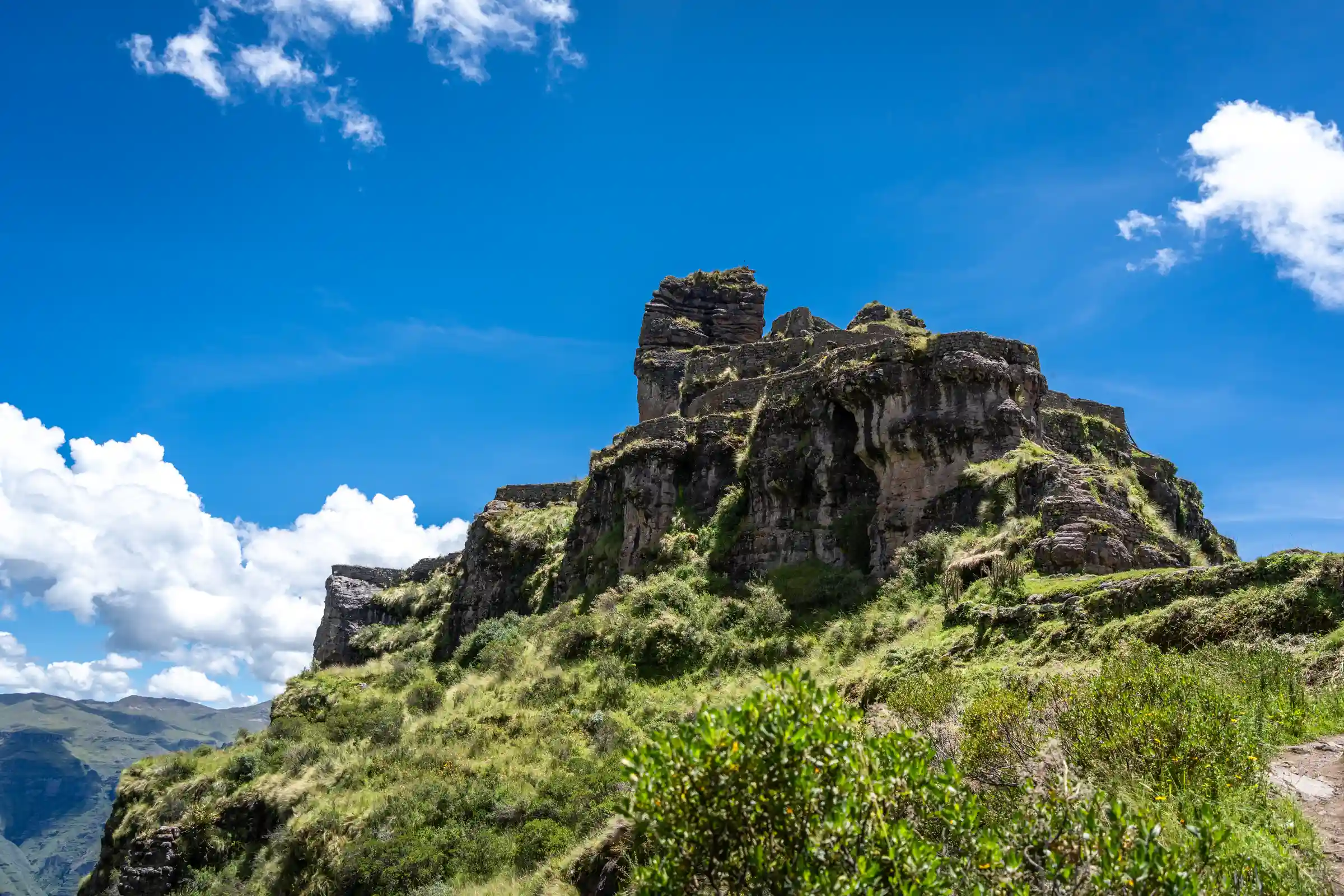
Its distinctive stone formations resemble two enormous horns rising above the canyon, giving the site one of the most recognizable silhouettes among the archaeological attractions of southern Peru.
Unlike Machu Picchu, Sacsayhuaman, or the Sacred Valley, Waqrapukara receives considerably fewer visitors. The journey requires traveling several hours outside Cusco and completing a hike through high-altitude terrain, making it especially attractive to travelers who want to explore beyond the traditional tourist routes.
This complete Waqrapukara Travel Guide from Machu Picchu Team in Cusco explains how to visit Waqrapukara, the different hiking routes, altitude, difficulty, best time to go, what to bring, what you will see, and how to prepare for this extraordinary Andean adventure.
Waqrapukara at a Glance
| Detail | Information |
|---|---|
| Destination | Waqrapukara Archaeological Complex |
| Region | Cusco, Peru |
| Province | Acomayo |
| Approximate altitude | Around 4,100–4,300 m / 13,450–14,100 ft |
| Tour duration | Full day |
| Hiking time | Approximately 2–4 hours depending on route |
| Difficulty | Moderate |
| Main attraction | Archaeological complex and canyon landscapes |
| Recommended acclimatization | At least 2 days in Cusco |
| Best general season | April to October |
| Rainier period | November to March |
| Tour type | Hiking and cultural excursion |
| Best for | Adventure, archaeology, photography and landscapes |
| Typical departure | Very early morning from Cusco |
What Is Waqrapukara?
Waqrapukara is an archaeological complex located on a dramatic rocky promontory overlooking the Apurímac River canyon system in the southern part of the Cusco region.
The site combines natural geological formations with walls, terraces, stairways, ceremonial spaces, enclosures, and other stone structures.
Its remote location gives Waqrapukara a completely different atmosphere from many archaeological sites closer to Cusco.
Rather than seeing a large urban settlement, travelers encounter a compact complex integrated into an extraordinary natural landscape.
The combination of cliffs, stone architecture, high-altitude grasslands, and canyon views makes Waqrapukara particularly impressive.
What Does Waqrapukara Mean?
The name Waqrapukara is generally associated with Quechua words commonly interpreted as:
Waqra = horn
Pukara = fortress
This leads to the popular translation:
“Horn Fortress.”
The name refers to the two dramatic rock formations rising above the archaeological complex.
However, the interpretation of Waqrapukara only as a military fortress is too simple.
The site likely had ceremonial, administrative, strategic, and symbolic importance.
Why Visit Waqrapukara?
Waqrapukara is ideal for travelers who want to experience something beyond the most famous attractions around Cusco.
Reasons to visit include:
- Spectacular Andean landscapes.
- Dramatic canyon views.
- Interesting Inca architecture.
- High-altitude hiking.
- Fewer visitors.
- Excellent photography.
- Combination of archaeology and nature.
- Opportunity to explore rural Cusco.
- Unique geological formations.
- Full-day adventure from Cusco.
For travelers who enjoy destinations such as Rainbow Mountain, Palcoyo, Humantay Lake, or remote archaeological sites, Waqrapukara can be an excellent addition to a Cusco itinerary.
Where Is Waqrapukara?
Waqrapukara is located southeast of Cusco in the province of Acomayo.
The archaeological complex lies in a remote high-Andean environment surrounded by mountain grasslands and deep river canyons.
Unlike Sacsayhuaman or Pisac, Waqrapukara cannot simply be reached by driving directly to the entrance.
Visitors usually travel by road from Cusco and then complete a hike to reach the archaeological site.
How Far Is Waqrapukara From Cusco?
Traveling from Cusco to the hiking area generally takes several hours.
The exact travel time depends on:
- Starting point of the hike.
- Road conditions.
- Weather.
- Chosen route.
- Type of transportation.
Because of the distance and hiking time, Waqrapukara is normally visited as a full-day excursion.
How Do You Get to Waqrapukara?
There are several approaches to Waqrapukara.
The most practical way for first-time visitors is through an organized tour from Cusco.
A typical journey involves:
- Early pickup in Cusco.
- Overland transportation south of the city.
- Breakfast or short stop depending on the tour.
- Arrival at the trailhead.
- Hike to Waqrapukara.
- Guided archaeological visit.
- Hike back to transportation.
- Lunch depending on the itinerary.
- Return to Cusco.
Different operators may use different trailheads.
Different Hiking Routes to Waqrapukara
One important thing travelers should understand is that there is not only one route.
Different access points can create different hiking experiences.
Some routes are shorter and easier.
Others involve longer walks through spectacular landscapes.
The exact route may depend on:
- Weather.
- Road conditions.
- Tour operator.
- Group fitness.
- Season.
Always check the hiking distance and estimated duration when booking.
Typical Waqrapukara Full-Day Tour
Although itineraries vary, a typical excursion works approximately as follows.
Early Morning: Departure From Cusco
The day usually begins very early.
Travelers leave Cusco before sunrise or shortly afterward.
Early departure is necessary because Waqrapukara is located several hours from the city.
The drive crosses rural areas south of Cusco.
Depending on the route, travelers may see:
- Small villages.
- Agricultural fields.
- High-Andean landscapes.
- Lakes.
- Mountains.
- Traditional communities.
Breakfast Stop
Many organized tours include breakfast before beginning the main hike.
A light breakfast is useful because hiking at altitude requires energy.
Avoid eating excessively heavy food immediately before walking.
Arrival at the Trailhead
After leaving the main roads, transportation continues toward the chosen hiking area.
The final road sections can be rural and more basic than highways around Cusco.
Once the group arrives, the guide normally provides instructions before hiking.
Hike to Waqrapukara
The trail crosses open Andean terrain.
Depending on the route, travelers may walk through:
- Grasslands.
- Rolling hills.
- Rocky paths.
- Mountain valleys.
- Canyon viewpoints.
- Streams.
- Rural landscapes.
As the trail approaches Waqrapukara, the terrain becomes increasingly dramatic.
Eventually, the distinctive horn-shaped formations become visible.
First Views of Waqrapukara
Seeing Waqrapukara for the first time is one of the highlights of the excursion.
The site appears above a deep canyon, surrounded by massive rock formations.
From certain viewpoints, the archaeological complex seems almost suspended above the landscape.
This is one of the best locations for photography.
Guided Visit at Waqrapukara
After reaching the archaeological complex, the guide normally explains the historical and architectural importance of the site.
Visitors may observe:
- Stone walls.
- Terraces.
- Doorways.
- Staircases.
- Ceremonial spaces.
- Natural rock formations.
- Canyon views.
The visit usually includes enough time for photographs and rest.
Return Hike
After exploring Waqrapukara, the group begins hiking back toward transportation.
Depending on the route, the return may follow the same trail or another path.
The return often feels easier because travelers are already familiar with the terrain, although altitude can still cause fatigue.
Lunch and Return to Cusco
Many organized tours include lunch before or after the hike.
Afterward, travelers begin the drive back to Cusco.
Arrival is usually in the evening.
Because this is a long day, avoid scheduling another demanding activity immediately afterward.
How Difficult Is the Waqrapukara Hike?
Waqrapukara is generally considered a moderate hike.
It is not technically difficult.
Travelers do not need:
- Climbing equipment.
- Ropes.
- Mountaineering experience.
However, the altitude makes the experience more challenging.
The main difficulties include:
- High elevation.
- Uneven terrain.
- Cold wind.
- Strong sun.
- Long travel day.
- Uphill sections.
A traveler with average fitness who has acclimatized properly can usually complete the hike.
Is Waqrapukara Harder Than Rainbow Mountain?
For many travelers, Waqrapukara may feel easier because the gradient can be more gradual depending on the chosen route.
However, both destinations are at high altitude.
| Waqrapukara | Rainbow Mountain |
| Archaeology + hiking | Mountain landscape |
| Moderate hike | Steeper final climb |
| Around 4,100–4,300 m | Over 5,000 m |
| Fewer visitors | More visitors |
| Canyon landscapes | High mountain scenery |
| Longer sightseeing experience | Shorter time at destination |
Travelers particularly concerned about extreme altitude may find Waqrapukara more manageable than Rainbow Mountain.
Is Waqrapukara Harder Than Humantay Lake?
The difficulty depends on fitness.
Humantay contains a relatively steep climb.
Waqrapukara usually involves a longer but more gradual walking experience.
| Waqrapukara | Humantay Lake |
| Moderate gradient | Steeper ascent |
| Archaeological site | Glacial lake |
| Canyon environment | Mountain environment |
| Around 4,100–4,300 m | Around 4,200 m |
| Multiple trail options | More direct trail |
Both require acclimatization.
Waqrapukara Altitude
Waqrapukara lies at approximately 4,100–4,300 meters above sea level, depending on the specific point measured.
This means it is significantly higher than Cusco.
| Location | Approximate Altitude |
| Cusco | 3,400 m / 11,155 ft |
| Waqrapukara area | Around 4,100–4,300 m / 13,450–14,100 ft |
| Machu Picchu | 2,430 m / 7,972 ft |
The altitude is one of the most important considerations when planning the excursion.
Can You Get Altitude Sickness at Waqrapukara?
Yes.
Altitude sickness can affect travelers above approximately 2,500 meters, and Waqrapukara is considerably higher.
Possible symptoms include:
- Headache.
- Shortness of breath.
- Fatigue.
- Nausea.
- Dizziness.
- Reduced appetite.
The best strategy is to acclimatize before the trip.
How Many Days Should You Acclimatize?
Spend at least two full days in Cusco or the Sacred Valley before visiting Waqrapukara.
Three days can be even better.
Good acclimatization activities include:
- Walking through Cusco.
- Visiting the Sacred Valley.
- Exploring nearby archaeological sites.
Avoid making Waqrapukara your first activity immediately after flying into Cusco.
How to Prepare for the Altitude
Before the excursion:
- Sleep well.
- Drink enough water.
- Avoid excessive alcohol.
- Eat a balanced dinner.
- Acclimatize properly.
- Avoid strenuous activity the night before.
During the hike:
- Walk slowly.
- Take short steps.
- Drink water regularly.
- Rest when needed.
- Communicate with your guide.
Never try to compete with other hikers.
Best Time to Visit Waqrapukara
Waqrapukara can be visited throughout much of the year.
However, the drier months generally offer better hiking conditions.
Dry Season
The dry season usually extends approximately from April or May through October.
Advantages include:
- Less rain.
- Clearer views.
- Drier trails.
- Better photography.
- Easier road conditions.
June, July, and August are among the driest months.
Rainy Season
The rainier period generally runs from approximately November to March.
During this period, travelers may experience:
- Rain.
- Mud.
- Cloud cover.
- Slippery paths.
- Greener landscapes.
- More dramatic skies.
Waqrapukara can still be beautiful during the rainy season.
The surrounding valleys become intensely green.
However, weather can affect road and trail conditions.
Waqrapukara by Month
| Month | General Conditions |
| January | Rainy |
| February | Rainy |
| March | Rain decreasing |
| April | Good transition |
| May | Excellent |
| June | Excellent and dry |
| July | Very dry, cold mornings |
| August | Excellent |
| September | Very good |
| October | Good |
| November | Increasing rain |
| December | Rainy |
Mountain weather remains unpredictable throughout the year.
What Is the Best Time of Day to Visit?
Most travelers arrive during the late morning or early afternoon because of the long journey from Cusco.
Morning light can be excellent for photography.
Clouds often develop later in the day during the rainy season.
Organized tours generally coordinate the schedule according to transportation and hiking conditions.
Waqrapukara Weather
Weather can change quickly.
Travelers may experience:
- Strong sunshine.
- Cold wind.
- Clouds.
- Rain.
- Cold mornings.
- Warm periods while hiking.
Layering is essential.
What to Wear to Waqrapukara
Recommended clothing includes:
- Breathable shirt.
- Hiking pants.
- Fleece.
- Waterproof jacket.
- Comfortable hiking shoes.
- Hat.
- Sunglasses.
During colder months, also consider:
- Gloves.
- Warm hat.
- Light insulated jacket.
Best Shoes for Waqrapukara
Use footwear with good grip.
Recommended options include:
- Hiking shoes.
- Trail-running shoes.
- Lightweight hiking boots.
Avoid:
- Smooth sneakers.
- Sandals.
- Formal shoes.
Trails can become muddy or slippery after rain.
Do You Need Hiking Boots?
Heavy hiking boots are not required for most visitors.
Light hiking shoes with good traction are usually sufficient.
However, travelers who prefer more ankle support may choose boots.
Should You Bring Trekking Poles?
Trekking poles are optional but useful.
They can help with:
- Balance.
- Uphill sections.
- Uneven trails.
- Descents.
Travelers with knee discomfort may find them particularly helpful.
What to Pack for Waqrapukara
Carry a small backpack.
Essential items include:
- Water.
- Sunscreen.
- Sunglasses.
- Hat.
- Rain jacket.
- Warm layer.
- Personal medication.
- Camera or phone.
- Snacks.
- Small amount of cash.
- Toilet paper or tissues.
- Hand sanitizer.
Waqrapukara Packing Checklist
| Item | Priority |
| Comfortable hiking shoes | Essential |
| Water | Essential |
| Sunscreen | Essential |
| Hat | Essential |
| Sunglasses | Essential |
| Waterproof jacket | Essential |
| Warm layer | Essential |
| Small backpack | Essential |
| Personal medication | Essential |
| Trekking poles | Optional |
| Camera | Recommended |
| Portable charger | Recommended |
| Snacks | Recommended |
How Much Water Should You Bring?
Bring enough water for several hours of hiking.
Your tour may provide some water or have opportunities to refill, but travelers should never assume water will be easily available near the archaeological site.
Carry a reusable bottle when possible.
Food During the Waqrapukara Tour
Many organized tours include:
- Breakfast.
- Lunch.
Travelers may also carry small snacks.
Good options include:
- Nuts.
- Energy bars.
- Dried fruit.
- Chocolate.
- Crackers.
Avoid carrying excessive food.
Are There Restaurants at Waqrapukara?
Do not expect conventional tourism restaurants at the archaeological site.
Waqrapukara is remote.
Meals are generally organized at communities or restaurants along the transport route.
This is another reason organized tours are convenient.
Are There Toilets?
Facilities are limited.
Use available bathrooms before beginning the hike when possible.
Carry:
- Toilet paper.
- Hand sanitizer.
Travelers should respect the environment and avoid leaving waste.
Is There Phone Signal?
Mobile coverage may be weak or unavailable in remote sections.
Do not depend on constant internet access.
Inform family or friends that you may be offline for much of the day.
Waqrapukara History
The archaeological history of Waqrapukara reflects the complex development of societies in the Cusco region.
The site is often associated with pre-Inca populations and later Inca occupation or modification.
Its strategic position above the canyon would have allowed extensive observation of the surrounding territory.
The architecture suggests that Waqrapukara was more than simply a military structure.
Possible functions may have included:
- Ceremonial activities.
- Territorial control.
- Administration.
- Religious significance.
- Observation.
Its dramatic natural setting may also have had symbolic importance within Andean worldviews.
Waqrapukara Architecture
The complex demonstrates how Andean builders incorporated natural rock into architecture.
Visitors can observe:
- Stone enclosures.
- Walls.
- Terraces.
- Staircases.
- Doorways.
- Platforms.
Rather than completely transforming the landscape, builders worked with the existing rock formations.
This relationship between architecture and nature is one of the most fascinating aspects of Waqrapukara.
The Horn-Shaped Rocks
The two enormous formations rising above the complex are responsible for Waqrapukara’s most famous appearance.
From certain angles, they resemble two horns.
From others, they appear like natural towers protecting the archaeological site.
Their unusual shape makes Waqrapukara instantly recognizable.
Canyon Views
The archaeological site overlooks a deep canyon carved by the river system.
From the viewpoints, travelers can see:
- Steep cliffs.
- River valleys.
- Andean grasslands.
- Massive rock formations.
- Distant mountains.
The scenery is often as memorable as the archaeological complex itself.
Wildlife Around Waqrapukara
The high-Andean environment supports wildlife adapted to altitude.
Travelers may encounter or observe:
- Andean birds.
- Hawks.
- Small mountain animals.
- Alpacas.
- Llamas.
- Sheep.
Wildlife sightings vary according to season and location.
Waqrapukara Photography Tips
Waqrapukara is excellent for photography.
Photograph the Site From a Distance
Some of the best photographs show the entire archaeological complex surrounded by canyon walls.
Do not immediately rush toward the entrance.
Take time to photograph the wider landscape.
Use People for Scale
Including a person in a wide photograph can demonstrate how enormous the surrounding cliffs are.
Use a Wide-Angle Lens
Wide perspectives work particularly well for:
- Canyon landscapes.
- Rock formations.
- Archaeological structures.
Protect Your Camera
Carry rain protection.
Weather can change quickly.
Bring Extra Battery
The long day and cold temperatures can reduce battery performance.
A portable charger can be helpful.
Is Waqrapukara Crowded?
Waqrapukara generally receives fewer visitors than:
- Machu Picchu.
- Rainbow Mountain.
- Humantay Lake.
- Sacred Valley.
This is one of its biggest advantages.
However, popularity has increased.
Certain days and periods may still have groups at the main archaeological site.
Travelers seeking the quietest experience should consider traveling outside peak holiday periods.
Is Waqrapukara Worth Visiting?
Yes, particularly for travelers interested in:
- Archaeology.
- Hiking.
- Photography.
- Mountain landscapes.
- Less crowded destinations.
It is one of the best excursions around Cusco for travelers who have already seen the major attractions.
Waqrapukara vs Rainbow Mountain
Choose Waqrapukara if you prefer:
- Archaeology.
- Canyon landscapes.
- Fewer crowds.
- Moderate hiking.
- Cultural history.
Choose Rainbow Mountain if you prefer:
- High mountain scenery.
- Colorful geology.
- Higher altitude.
- Famous photography.
Waqrapukara vs Palcoyo
Both can appeal to travelers looking for less crowded alternatives.
| Waqrapukara | Palcoyo |
| Archaeological focus | Geological focus |
| Canyon landscapes | Rainbow mountains |
| Moderate hiking | Relatively easier walking |
| Around 4,100–4,300 m | Higher altitude |
| Ancient structures | Natural formations |
Travelers with enough time could visit both on separate days.
Waqrapukara vs Humantay Lake
Choose Waqrapukara for:
- Archaeology.
- Canyons.
- Cultural history.
Choose Humantay for:
- Glacial landscapes.
- Turquoise lake.
- Mountain scenery.
Both involve high-altitude hiking.
Waqrapukara vs Machu Picchu
These sites should not be compared as alternatives.
Machu Picchu is one of the largest and most important archaeological attractions in Peru.
Waqrapukara is a much smaller and more remote experience.
A traveler should normally prioritize Machu Picchu first.
Waqrapukara is ideal as an additional adventure.
Who Should Visit Waqrapukara?
Waqrapukara is particularly suitable for:
- Active travelers.
- Couples.
- Photographers.
- Adventure travelers.
- Archaeology enthusiasts.
- Travelers who enjoy remote destinations.
- Visitors with extra days in Cusco.
Who Should Avoid Waqrapukara?
The excursion may not be ideal for travelers who:
- Have not acclimatized.
- Have serious mobility limitations.
- Struggle with several hours of walking.
- Have health conditions affected by altitude.
- Want a short or relaxing sightseeing day.
Choose an excursion suited to your physical condition.
Waqrapukara With Children
Older children and teenagers accustomed to hiking may enjoy Waqrapukara.
Parents should consider:
- Altitude.
- Walking duration.
- Cold.
- Sun exposure.
- Long transportation.
This may not be the best excursion for very young children.
Waqrapukara for Older Travelers
Active older travelers can complete the hike successfully.
Physical fitness is more important than age alone.
Consider:
- Knee condition.
- Balance.
- Cardiovascular fitness.
- Altitude tolerance.
Trekking poles can provide additional stability.
Can Beginners Hike Waqrapukara?
Yes.
A reasonably fit beginner can usually complete the hike if properly acclimatized.
However, travelers should have some experience walking for several hours.
A few weeks of preparation can improve the experience considerably.
How to Train for Waqrapukara
Before traveling, practice:
- Walking.
- Hills.
- Stairs.
- Light hiking.
You do not need intensive trekking training.
The most important preparation is improving general cardiovascular fitness and acclimatizing after arriving in Cusco.
Waqrapukara as an Acclimatization Hike
Despite being less difficult than some mountain routes, Waqrapukara is not ideal as your first acclimatization activity because it reaches more than 4,000 meters.
Start with lower activities such as:
- Cusco City Tour.
- Sacred Valley.
- Maras and Moray.
Then visit Waqrapukara after your body has adjusted.
Suggested Cusco Itinerary Including Waqrapukara
| Day | Activity |
| Day 1 | Arrive in Cusco and rest |
| Day 2 | Cusco City Tour |
| Day 3 | Sacred Valley |
| Day 4 | Waqrapukara |
| Day 5 | Machu Picchu |
| Day 6 | Free day |
Another option is to visit Waqrapukara after Machu Picchu.
Waqrapukara Before Rainbow Mountain
Travelers planning both activities should avoid scheduling them immediately after arriving in Cusco.
A good order could be:
Cusco → Sacred Valley → Waqrapukara → rest → Rainbow Mountain
Waqrapukara can provide some additional experience walking at high altitude before attempting a destination above 5,000 meters.
Can You Visit Waqrapukara Independently?
Independent travel is possible for experienced travelers familiar with rural transportation and hiking.
However, logistics can be complicated.
Challenges include:
- Reaching the correct trailhead.
- Limited transportation.
- Road conditions.
- Trail navigation.
- Language barriers.
- Return transportation.
For most international visitors, an organized tour is significantly easier.
Group Tour or Private Tour?
Both options work.
Group Tour
Best for:
- Budget travelers.
- Solo travelers.
- Visitors who do not need flexibility.
Private Tour
Best for:
- Families.
- Couples.
- Photographers.
- Travelers who want to hike at their own pace.
- Visitors wanting more flexibility with stops.
Advantages of a Private Waqrapukara Tour
Private tours generally allow:
- Flexible pacing.
- More photography time.
- Personalized guiding.
- Easier rest stops.
- Adaptation to individual fitness.
This can be particularly valuable for a remote destination.
What Should a Waqrapukara Tour Include?
Before booking, check whether the tour includes:
- Transportation.
- Professional guide.
- Breakfast.
- Lunch.
- Entrance fee.
- First-aid equipment.
- Emergency oxygen when appropriate.
Also confirm:
- Hiking route.
- Approximate hiking time.
- Pickup location.
- Return time.
Responsible Travel at Waqrapukara
Remote destinations require responsible behavior.
Visitors should:
- Stay on established trails.
- Avoid damaging archaeological structures.
- Do not climb walls.
- Carry out all trash.
- Respect local communities.
- Avoid disturbing animals.
- Follow guide instructions.
- Use reusable bottles when possible.
Do Not Climb Archaeological Walls
Stone structures are part of Peru’s cultural heritage.
Climbing them can cause damage.
Use designated paths and viewpoints.
Leave No Trash
Carry everything back with you.
This includes:
- Food packaging.
- Plastic bottles.
- Tissues.
- Wet wipes.
Remote environments are especially vulnerable because waste collection infrastructure is limited.
Respect Local Communities
The route passes through rural areas where tourism shares space with agriculture and local life.
Travel respectfully.
Ask before photographing people closely.
Support local businesses when appropriate.
Common Mistakes When Visiting Waqrapukara
Mistake 1: Visiting Immediately After Arriving in Cusco
The altitude can make the hike unnecessarily difficult.
Mistake 2: Underestimating the Cold
High-altitude wind can feel very cold even on sunny days.
Mistake 3: Forgetting Sunscreen
Andean ultraviolet exposure is strong.
Mistake 4: Wearing Poor Footwear
Trails can be uneven and slippery.
Mistake 5: Carrying Too Much
A heavy backpack makes altitude more difficult.
Mistake 6: Walking Too Fast
A slower pace is more efficient above 4,000 meters.
Mistake 7: Forgetting Rain Protection
Mountain conditions can change rapidly.
Mistake 8: Comparing It With Machu Picchu
Waqrapukara offers a completely different experience.
Visit it for the combination of hiking, landscapes, archaeology, and isolation.
Frequently Asked Questions About Waqrapukara
What is Waqrapukara?
Waqrapukara is a remote archaeological complex located above a dramatic canyon southeast of Cusco.
What does Waqrapukara mean?
The name is commonly interpreted as “Horn Fortress.”
Where is Waqrapukara?
It is located in the Acomayo province of the Cusco region.
How high is Waqrapukara?
The site is approximately 4,100–4,300 meters above sea level.
Is Waqrapukara higher than Cusco?
Yes.
Cusco is approximately 3,400 meters above sea level.
How long does the Waqrapukara tour take?
It is normally a full-day excursion from Cusco.
How long is the hike?
The hiking portion usually takes approximately 2–4 hours, depending on the chosen route and group pace.
Is Waqrapukara difficult?
The hike is generally considered moderate.
Altitude is the main challenge.
Do I need hiking experience?
No technical hiking experience is necessary.
Basic fitness and proper acclimatization are more important.
Do I need hiking boots?
Comfortable hiking shoes with good traction are recommended.
Heavy trekking boots are not usually necessary.
Do I need trekking poles?
They are optional but can help with balance and downhill sections.
What is the best time to visit Waqrapukara?
The drier months from approximately April to October generally provide the best hiking conditions.
Can I visit during the rainy season?
Yes, but expect wetter trails, clouds, mud, and changing road conditions.
Can I visit Waqrapukara in January?
It is possible depending on weather and road conditions, but January is part of the rainy season.
Is Waqrapukara crowded?
It generally receives significantly fewer visitors than Machu Picchu or Rainbow Mountain.
Can children visit Waqrapukara?
Active older children with hiking experience may be able to complete the excursion.
Parents should consider altitude and the long travel day.
Can older travelers visit?
Yes, provided they have appropriate fitness and mobility.
Can beginners hike Waqrapukara?
Yes.
Acclimatization and slow pacing are essential.
Is Waqrapukara suitable for altitude acclimatization?
It is better to acclimatize first because the destination itself exceeds 4,000 meters.
How many days should I stay in Cusco before Waqrapukara?
At least two days is recommended for most travelers.
Should I visit Waqrapukara or Rainbow Mountain?
Choose Waqrapukara for archaeology and canyon landscapes.
Choose Rainbow Mountain for high-altitude geological scenery.
Should I visit Waqrapukara or Palcoyo?
Waqrapukara provides more archaeology and hiking.
Palcoyo provides colorful mountain scenery with relatively easier walking.
Does Waqrapukara require a full day?
Yes.
The long road journey makes it impractical as a half-day excursion from Cusco.
Are there restaurants at Waqrapukara?
Not at the archaeological site itself.
Organized tours generally arrange meals elsewhere along the route.
Are there bathrooms?
Facilities are limited.
Use available bathrooms before starting the hike.
Is there internet or phone signal?
Signal can be limited or unavailable.
Can I visit without a guide?
It is possible for experienced independent travelers, but organized transportation and guiding make the trip considerably easier.
What should I bring?
Bring:
- Water.
- Hiking shoes.
- Warm clothing.
- Rain jacket.
- Sunscreen.
- Sunglasses.
- Hat.
- Personal medication.
- Small backpack.
- Camera.
Is Waqrapukara Worth Adding to Your Cusco Itinerary?
For travelers with enough time, absolutely.
Cusco offers many extraordinary archaeological sites, but Waqrapukara stands apart because of its remote setting.
The journey combines several elements:
road trip + high-altitude hike + archaeology + canyon landscapes + rural Peru.
It is especially worthwhile after visiting the better-known attractions.
Travelers spending five or more days in Cusco can consider adding Waqrapukara without sacrificing essential destinations such as Machu Picchu or the Sacred Valley.
Final Tips for Visiting Waqrapukara
A successful Waqrapukara trip begins with good preparation.
Remember:
Acclimatize first.
The archaeological site is above 4,000 meters.
Leave Cusco early.
This is a long full-day excursion.
Walk slowly.
Altitude matters more than speed.
Wear appropriate shoes.
The terrain is uneven.
Bring layers.
Temperatures change throughout the day.
Carry sun protection.
High-altitude sunlight can be intense.
Bring waterproof clothing.
Andean weather is unpredictable.
Pack lightly.
A small daypack is sufficient.
Bring water and snacks.
Services near the archaeological site are limited.
Respect the ruins.
Do not climb archaeological structures.
Take time to appreciate the landscape.
Waqrapukara is not only about the ruins.
The canyon, cliffs, high-Andean grasslands, and journey are all part of the experience.
Visit Waqrapukara With Machu Picchu Team
The Waqrapukara Archaeological Complex is one of the best places near Cusco for travelers who want to combine history, nature, hiking, and adventure away from the region’s busiest attractions.
Its dramatic horn-shaped rock formations, Inca architecture, canyon walls, and remote Andean setting create an experience that feels completely different from a conventional Cusco sightseeing tour.
At Machu Picchu Team, based in Cusco, we help travelers explore both the famous destinations and the lesser-known places that make the region extraordinary.
A well-planned itinerary can combine Cusco, the Sacred Valley, Machu Picchu, Maras, Moray, Waqrapukara, Rainbow Mountain, Humantay Lake, the Inca Trail, Salkantay Trek, and other adventures throughout the Peruvian Andes.
For travelers willing to leave Cusco before sunrise, hike above 4,000 meters, and travel beyond the classic tourism routes, Waqrapukara provides a rewarding experience.
The archaeological complex may be the destination, but the real attraction is the combination of ancient stonework, enormous landscapes, high-altitude silence, and the feeling of discovering another side of Cusco.